Saturday, September 17, 2022

14 September 2022 Gettysburg Battlefield

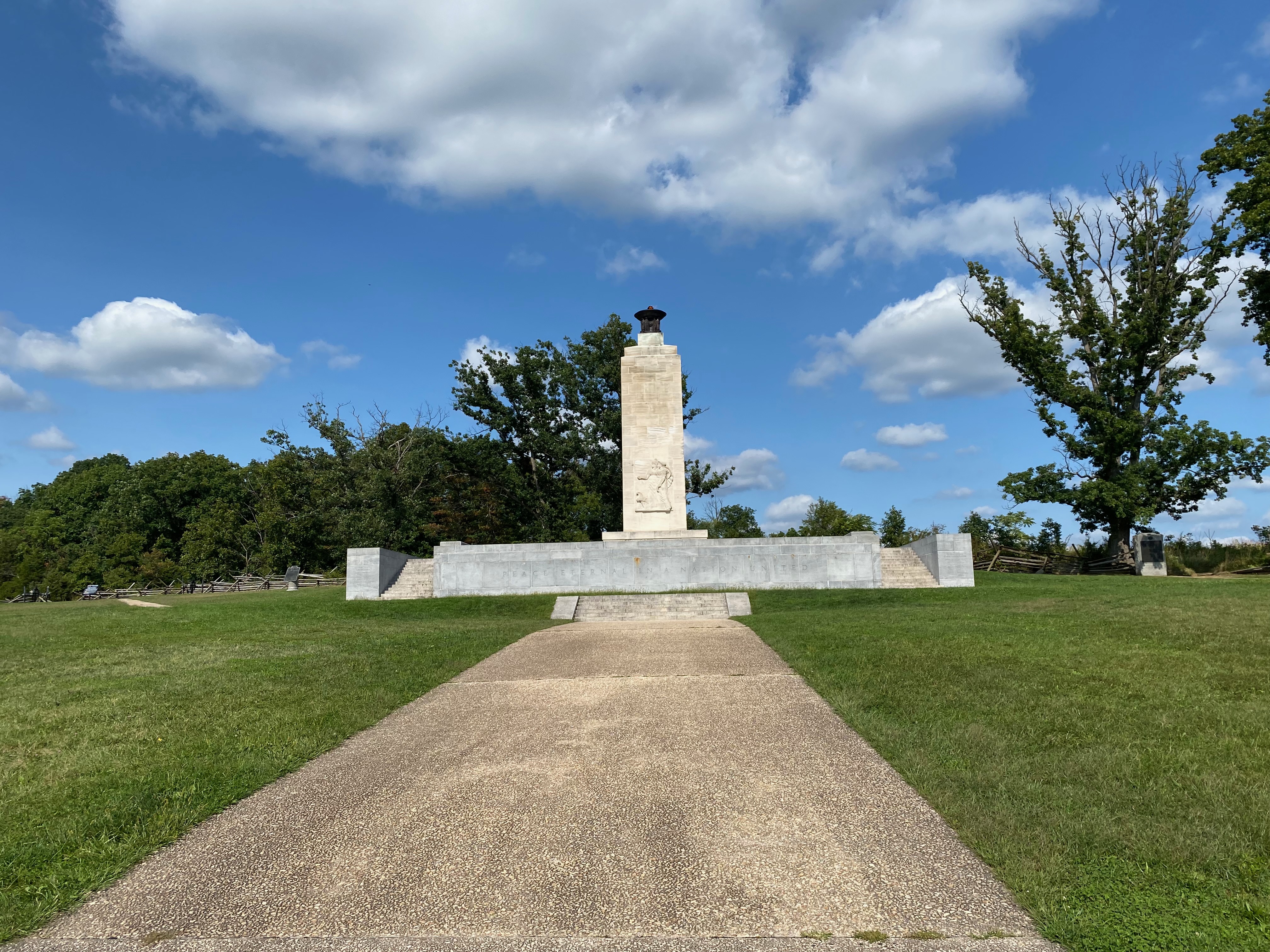
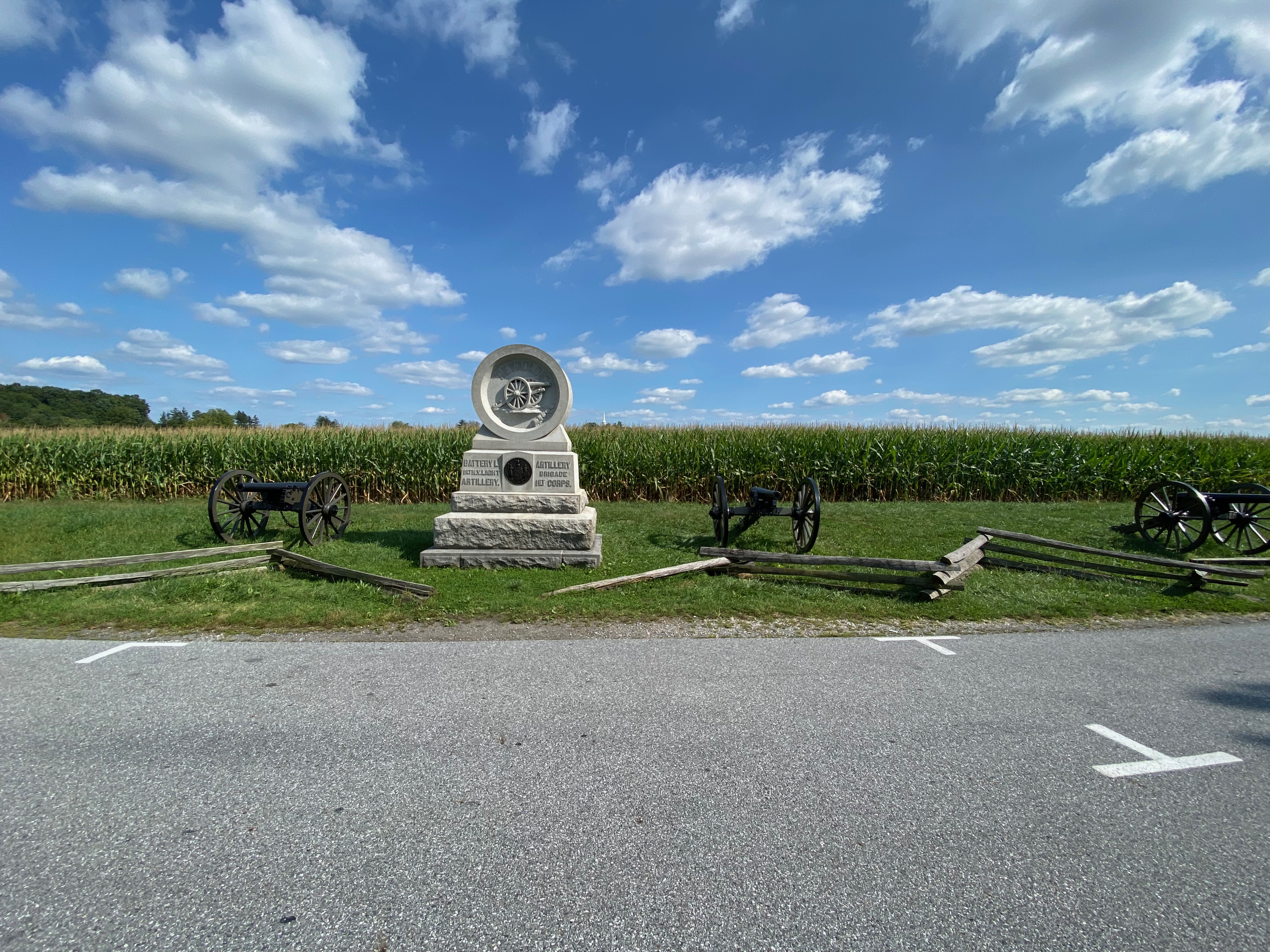
 We went to the Gettysburg National Military Park visitor center to kick off our visit. We’re not Civil War buffs, but we wanted to explore this famous battlefield. The visitor center is quite large. After collecting our passport stamp, we paid ($16 each) to view the park movie and the Cyclorama painting. This is the first time we have had to pay to see the park movie. We first viewed the movie, then went upstairs to see the cyclorama show. We don’t think it was worth the money. But it was interesting to see the historic cyclorama painting of Pickets Charge simply because of the artistry. Leslie had had the nail of her big toe worked on yesterday, so she was not feeling up to any long walks. After exploring the options for guided and self-guided tours, we decided to do the self-guided auto tour of the battlefield that is on the NPS app. We followed the tour signs and listen to the app describe the battle that occurred at each site over the three days (1-3 July 1863). Parts of the battlefield were closed for renovations. The battle field encompasses large swaths of land to the north, and east of the small town of Gettysburg. Over 1300 monuments dot the landscape as memorials to units and individuals, erected in the years since the battle (latest was in 1989). Seeing the field where the Confederates rose up from Seminary Ridge and marched in formation toward the Union Lines on Cemetery Ridge during Pickets Charge gives you a deep appreciation of the valor of the men in both armies during that battle. Over 12,000 men from various Confederate Army units (6,000 in Pickets Army) marched in tight formations extending almost a mile, across that open field with Union Artillery tearing huge holes in their ranks. Roughly two thirds of the way across the field, there was a fence along a road that slowed down the formations as they had to climb over or under the fence rails. Most of the formations never made it past the road. Only at one location, called The Angle (where the rock wall the Union Soldiers were using as cover made a 90 degree turn) did the confederates breach the Union lines. Union reinforcements quickly arrived to push them back. Faced with either surrender or having to go back across that open field under Union fire, many surrendered. Of the 12,000 that started the charge, 6000 were casualties (dead or wounded) and less than 3000 made it back to Seminary Ridge. The next day, under cover of heavy rain, the Confederate Army retreated from Pennsylvania. In one part of the battlefield, there is a peace monument built in 1937 and dedicated in 1938. Surprisingly, considering it was 75 years after the battle, over 1,300 survivors of the battle were at the dedication. 


At the end of the tour, we explored the soldier cemetery where the 3500+ Union casualties were reburied. Immediately after the battle, the dead were buried in shallow graves where they fell, many with wooden markers identifying who they were. . In the ensuing months, rains and animals uncovered many dead. The Pennsylvania government bought land on Cemetery Ridge overlooking the field where Pickets Charge took place and built a cemetery for the Union dead. Over the next 6 months, Union dead were dug up and reinterred in the new cemetery. Over 900 bodies could not be identified and are buried in numbered plots. Confederate dead were buried in mass graves. After the war, Confederate dead were removed and buried in cemeteries in the south. It was at this Soldiers Cemetery that President Lincoln delivered his famous Gettysburg speech. Of the 165,000 soldiers involved in this battle, over 50,000 were wounded, over 7,000 killed from both sides. 
Soldiers National Cemetery, graves of the unknown

Soldiers National Cemetery

Monument at Soldiers National Cemetery

Monument to Lincolns Gettysburg Address

View of the field that Pickets Charge occurred from the Union lines on Cemetery Ridge. This is The Angle where Confederate soldiers briefly broke through Union lines.

The field where Pickets Charge occurred from the Confederate lines on Seminary Ridge.

Monument to North Caroline troops

Peace Monument

Monument to Union Artillery

Cyclorama painting of Pickets Charge

Cyclorama of Pickets Charge

Entrance Sign

12 September 2022 Hershey to Gettysburg

 Our drive to Gettysburg was only 64 miles. It was a nice casual drive on good roads. We once again found ourselves on US30 for part of the drive. We are staying at Gettysburg Campground ($93 per night, no discount) which is a sister to the Hershey campground we were staying in. This is a large campground that was pretty empty. Our site at the end of a row was difficult to pull into because of the angles, but we worked our way into. After we had gotten set up, a huge class A pulled into the site directly next to us. They had problems getting into their site also. We could almost reach through the window and touch their rig. Why they placed us side-by side on this row when there are large numbers of open pull through sites on this row? Sometimes RV campground management practices make no sense to us campers. 

Tuesday, September 13, 2022

11 September 2022 Independence and First State

 Being so close to Philadelphia (only an hour and a half away), we wanted to visit the city to see the Independence Historical National Park and get an authentic Philly Cheese Steak Sandwich. Thanks to Lauren and Bryan’s help, we located a parking lot in central Philadelphia that could take the Behemoth. After parking, we walked in the occasional rain shower to Woodrow’s Sandwich shop (a DDD restaurant) and David had a Philly Cheese Steak Sandwich for lunch (Check that one off). We then walked to Independence Hall only to learn they had instituted a reservation system for touring Independence Hall. We got on line but found the next available tour was not for over an hour. Since we had other plans, we decided to skip the tour of Independence Hall (Leslie had toured it once before and David had seen enough pictures) and went over to the Liberty Bell Museum. While touring the exhibits before getting to the bell, we learned that they are not even sure if the bell was rung when the Declaration of Independence was first signed. Independence Hall and previously been the Pennsylvania State House and the bell was housed in the original bell tower and used to ring in various events. The bell originally cracked twice, prior to the Continental Congress first meet there. Two attempts to repair the cracks failed in time. The crack as we see it today did not occur until the 1780s. So it is interesting that there is such mistic about it when there is no historical record of it being rung for the American independence movement. We then walked back to the Behemoth and set our sites for Delaware. Being so close, we decided we needed to go to Delaware so we could check it off our list. We decided to visit one of the units of the First State Historical National Park. It was originally made a National Monument in 2014 by President Obama after several failed attempts to create a national park by congress. In 2015, congress changed it to a historical park. The unit we decided to go to was in New Castle Delaware. We arrived around 3PM in New Castle and began searching for the historical park. After searching around, we stopped in the visitor center for the state park to learn that there was not a national park visitor center yet and that the old courthouse museum had already closed for the day. But they did have the park passport stamp, so we collected our stamp and wandered around the old square and down to the Warf on Chesapeake Bay. We decided to check if there was a vineyard nearby, but were surprised to find that there are only 2 vineyards in Delaware and they were in the southern part of the state. So we jumped in the Behemoth for the long drive in the rain back to the Wanderer. 

Davids Philly Cheese Steak

Independence Hall

Liberty Bell

Park sign for First State Historical Park

One of the streets in New Castle

Upper Chesapeake Bay with ice breaker islands in the foreground


10 September 2022 York

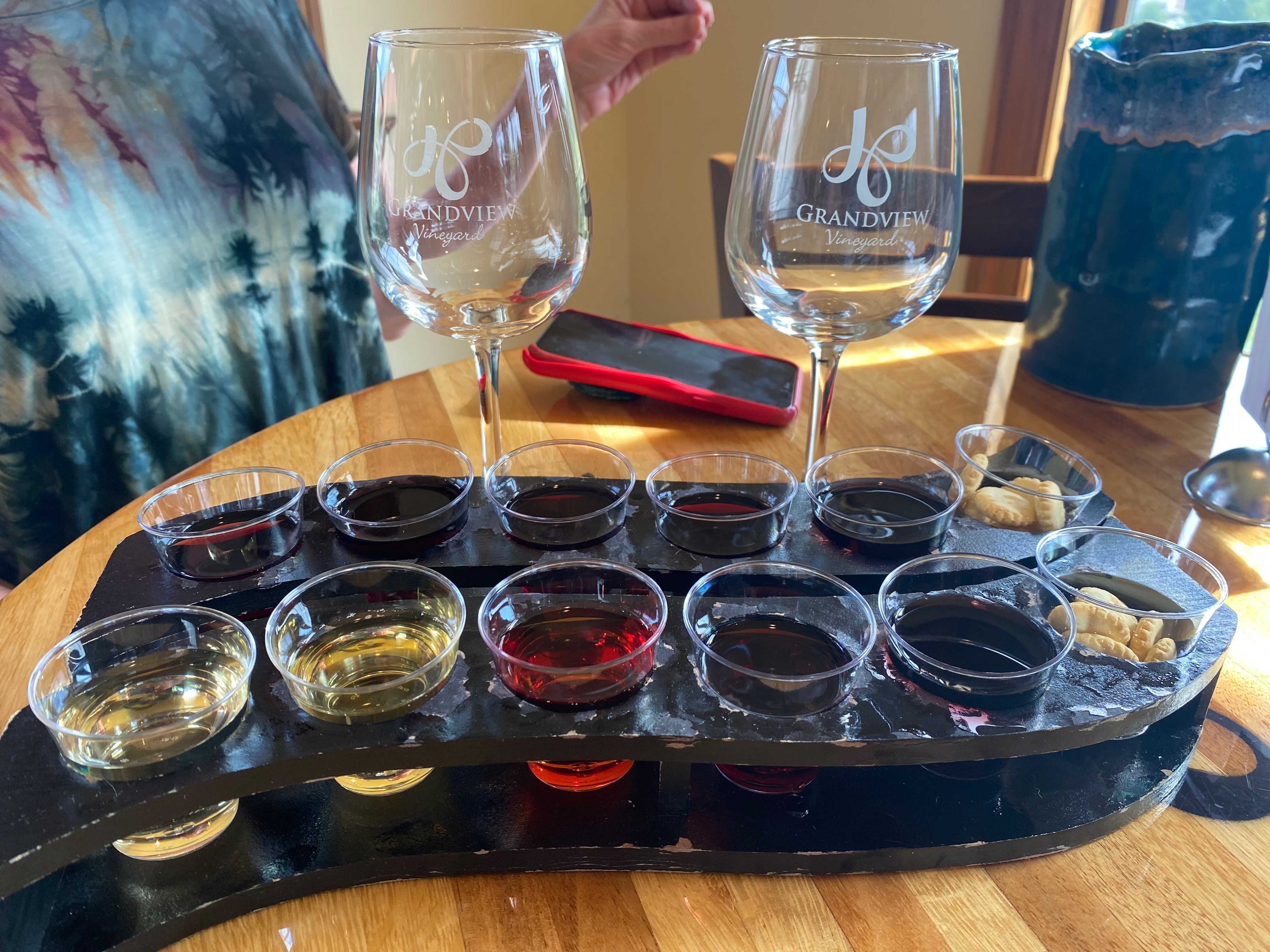
 After learning the Continental Congress had met in York to write the Articles of Confederation and where the Term “United States of America” was first used, we had high expectations of what we would find in the old town. We were disappointed. None of the colonial era buildings are left and there is very little to mark the importance of York in our early history. After a nice lunch at the White Rose, we wandered around the old town area of York. We visited the York Central Market House, which was built in 1888. Its now basically a big food court with a few retail vendors mixed in. We then sought out a vineyard and ended up at the Grandview Vineyard (our 15th state for wine tasting) in Mt Joy. We enjoyed our wine tasting and the grand views of the valley below but we did not pick up and bottles to bring home. 

Grandview wine samples


Central Market House built in 1888

Inside the central market

View from Grandview Vineyard Tasting Room

9 September 2022 Valley Forge

 On December 3 1777, units of the Continental Army began arriving in Valley Forge. Soon over 12,000 men and thousands of followers had covered the hills and ridges and began the task of cutting down trees and building almost 2000  log cabins to house the horde. General Washington had picked this location for strategic reasons. In late September 1777, the British Army had captured Philadelphia and the Continental Congress moved to York to avoid capture. Valley Forge is only 20 miles outside Philadelphia. Far enough to prevent a surprise attack by the British yet close enough that the Continental Army could keep an eye on the British. It also put the Continental Army in a position to block the British from attacking York and Lancaster. The area was originally family farms. But the fields were soon turned into churned mud as the Continental Army cut down all the trees to be used to build log houses, cook, heat and build defensive positions. The Army built extensive defensive position on the ridge tops and learned to be an army instead of disparate units in the large Grand Parade Ground in the depression between the ridges. The Continental Army occupied Valley Forge until June of 1778 when the British abandoned Philadelphia. Upwards of 2000 soldiers died in Valley Forge due to disease and starvation. But the army learned to be a disciplined force which significantly helped in the future battles. The drive over took us on US30 again. We have driven stretch of US30 from Oregon to New Jersey. Maybe one summer we will drive it from coast to coast. After going to the visitor center to view the park movie, collect our passport stamp and review of the exhibits, we decided to do the auto tour around the park. Very little of the original battlements are still viewable. After the army left in June 1778, the farmers reclaimed their land, tore down the cabins and plowed under the majority of the battlements. Several reproductions of the cabins built by the soldiers are spread around to be viewed. There are multiple monuments to individual units spread around the park. We then sought out a local brewery (La Cabra Brewery) for an adult beverage and a late lunch before the 1.5 hour drive back to the Wanderer.

Park Entrance Sign

Reproduction Log Cabins

The Grande Parade where the troops drilled

Victory Arch. Flag at half mast for Queen Elizabeths passing

General Washingtons Headquarterts in Valley Forge

Example to the Artillery Park where they held the artillery in readiness to move to any axis of attack

Reproduction 3 pounder

Line of cannons.


Thursday, September 8, 2022

7 September 2022 Chocolate, Chocolate, Chocolate

 Being in Hershey PA, one must visit the Hershey Chocolate plant. Unfortunately, they no longer offer plant tours since they opened the new plant in 1995. Instead, they have the Hershey Chocolate World. We decided to take the trolly tour of the town of Hershey. We arrived early at the Chocolate World and strolled through the extensive store to see what we might be interested in buying. The store is incredible with the selection of Hershey products (IE candy) and themed clothing. There are many Hershey Candy products in the store that we have never seen in the commercial stores. We also noted there is a Chocolate Tour ride that we decided we would do when we returned from the tour. We loaded up on the trolly and we were driven around (in the rain) the town. The guide kept up an amusing commentary the whole ride with facts about the Hershey company, Milton Hershey and his family, and the many things Milton Hershey built and did to support his employees. We learned many things we did not know about Milton Hershey. He failed six times with different candy companies before he succeeded with Hershey Chocolate. We learned about his wife and her early death and how that affected him. Also, about the orphanage that they built together (and is still running to this date) when they found out they could not have children. We learned about how Milton supported his employees during the depression and how he put his own fortune on the line to employ construction workers during the depression. Including a case where he told a supervisor to get rid of a steam shovel and hire more men to do that work. We learned that between the two factories (new Hershey’s Chocolate Factory and the Reeses plant, they turn out over 5 million pounds of chocolate candy a day and run around the clock, seven days a week, 365 days a year! That’s a lot of candy! Milton built the town and plant in this location due to the availability of fresh milk from the surrounding dairy farms. The cost of building the town and the factory here was cheaper than building a plant in a major city and shipping the milk in everyday. He knew that he needed to build a town for the workers to live in in this extremely rural location in 1903, and that good living conditions would ensure good workers.

When we returned to the Hershey Chocolate World, we walked over to the Chocolate tour and walked through the exhibits on how coco beans, sugar and milk are turned into Hershey’s chocolate. At the end of the exhibits is a ride that takes you through a simulated chocolate factory that is a bit hokey. Back at the store we grabbed a basket and went chocolate shopping! Most of it is for other people, but we picked up some sugar free stuff for ourselves. 

Hershey Chocolate World Sign

Hershey World Store

The Chocolate Tour

Coco Trees in the store

Hershey Characters

Our basket full of chocolate

Hershey Kisses Street Lamps


5 September 2022 Clinton CT to Hershey PA

 The drive to our next location was a bit intense.  The roads were rough with lots of big bumps with the expansion joints. In Pennsylvania, the toll road had a long stretch of construction where we were required to be in the left lane with the concrete barriers just inches away from the driver’s side of the Wanderer and inches  from the vehicles in the right lane. Then it started raining hard. At one point, we had to cross through a stretch of water on the road the the Wanderer did a little slip to the right. Fortunately, there was no one in the right lane and we kept the Behemoth in front of the Wanderer. A real white-knuckle stretch. We are staying at the Hershey Road Campground ($113 per night, no discount. But we did get a reimbursement of our deposit from 2020). The RV site was easy to get into and we set up quickly before the next round of rain moved in. 

Hershey Road Campsite
'